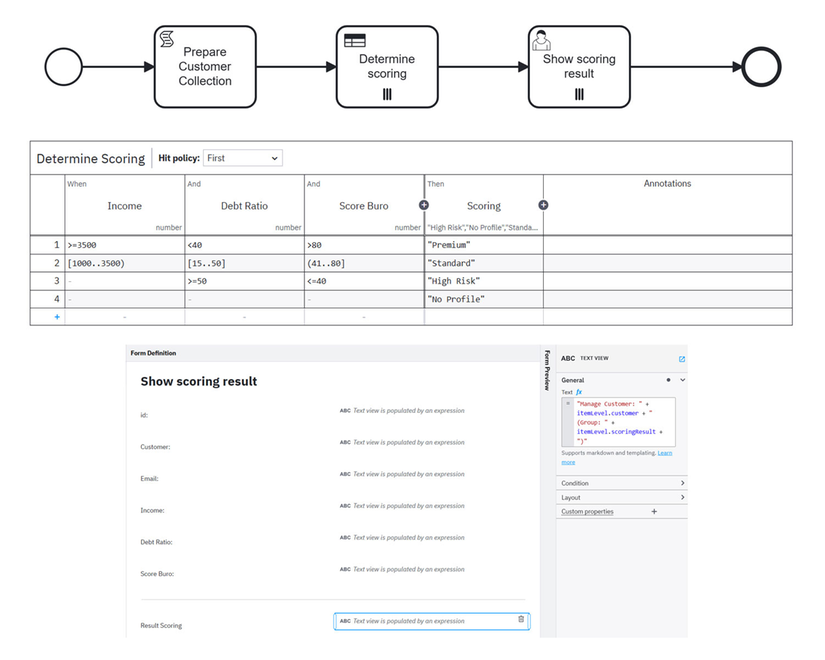
Score customer credit risk in parallel using DMN and FEEL
Credit scoring at scale requires consistent, auditable logic applied in parallel across many customers — often with different human review steps depending on the outcome. This blueprint orchestrates that process in Camunda using a parallel multi-instance pattern that iterates concurrently over a customer payload of up to 1,000 records per instance, maintaining full traceability in Camunda Operate. A DMN decision model with a first hit policy classifies each customer based on financial inputs such as income and credit history, assigning a risk category of premium, standard, high risk, or no profile. Human tasks then adapt their visibility and content to the scoring result, routing standard and high risk cases to the appropriate review path. FEEL expressions in the embedded Camunda form ensure reviewers see only the data relevant to each specific case.
Features and Benefits
Classify customers automatically using a DMN decision model
Adapt the review form dynamically based on scoring results
Details
- Marketplace release date -
- Last Github commit -
-
Associated Product Group Categories:
- Solution Accelerators
-
Version Compatibility:
-
Used resources: